

A longitudinal Case Study to Determine the Viability of HACCP Implementation in a South African Red Meat Processing Plant using Documentary Analysis (2009) , MSc Dissertation, Salford University, Manchester, UK by Reshmee Beedasie, Director, FoodTek Solutions (Pty) Ltd
ABSTRACT
Constraints and problems in the development and application of Hazard Analysis Critical Control Points (HACCP) still exist in developing countries. The implementation of HACCP in the South African Red Meat Industry has been categorized as being ‘difficult’, impractical and uses a trail of paperwork that hinders production to some extent. With consumers becoming more aware of food safety on a global level, this has filtered through to the Regulatory Authorities. With the promulgation of the Meat Safety Act (Act 40 of 2000) and the subsequent inclusion of the HACCP principles, it has become mandatory for all regulatory inspected abattoirs and meat processing plants to implement a hygiene management system. With the participation of the of the South African food industry in the export market, and major retailer competitiveness with regards to food safety, food manufacturing plants are under pressure to adhere to international food safety management systems i.e. HACCP
This study highlights the viability and practicalities of HACCP implementation at a South African Red Meat Processing Plant by means of documentary analysis of food safety related documentation.
The case study utilised the phased approach to HACCP implementation and started with the building of a solid foundation i.e. a solid Good Manufacturing Practices (GMP) system. Key factors such as management commitment, teamwork, documentation and record keeping and frequency of internal audits were considered to ensure the viability of the HACCP implementation process.
Keywords: HACCP, implementation, practicalities, documentary analysis, viability
- AIM OF RESEARCH
The primary aim of the project is to assess the practicalities of HACCP Implementation in a South African Red Meat Processing Plant by means of Documentary Analysis In order to achieve this aim, the following objectives or research questions will be answered.
- OBJECTIVES OF THE STUDY
- To undertake a study prior to HACCP Implementation at a South African Meat Processing Plant by means of a pre-assessment survey
- To analyse the HACCP Implementation process in a South African Meat Processing Plant by documentary analysis of food safety related documents i.e.
2.1 Internal Audit Reports
2.2 Minutes of HACCP Team Meetings
- To draw conclusions regarding practicalities of HACCP Implementation in a South African Meat Processing
- METHODOLOGY
A historical documentary analysis or content analysis was used to assess the practicalities of HACCP implementation in a South African Red Meat Processing Plant. As this was a desk top review, the resources for the study were limited to the documents analyzed and the time taken by the researcher to collect all necessary documents and analyze them. The following documents were analyzed for the period May 2006 to December 2008 which encompasses the period of HACCP implementation and certification at the South African Red Meat Processing Plant (SARMPP).
- Pre-assessment Report
- HACCP Meeting Minutes
- Internal Audit Reports
The above documents were then analyzed according to the following five categories:
- Personnel Hygiene
- Cleaning and Sanitation
- Pest Control
- Construction and Maintenance
- Production and Process Control
- Documentation
The rationale for the above categories are as follows: According to the Codex Alimentarius Food Hygiene Basic Texts (2001), the table of content specifies ten sections pertaining to food hygiene.
Good Manufacturing Practices (GMP) are the minimum control measures, actions, procedures and policies that may have to be implemented to ensure a consistent quality product that conforms to local and national health regulations, in-house specifications and international requirements.
According to the CSIR Biochemtek GMP Training Manual (2002), the GMP system can be divided into five different aspects as follows:
- Personnel Hygiene
- Cleaning and Sanitation
- Pest Control
- Construction and Maintenance
- Production and Process Control
The documentation aspect was included as a category in the study due to the importance of documentation in a food safety management system.
The above five aspects can be equated to the sections of Codex Alimentarius as per Table below.
Table 1 showing Relationship between Codex Sections and GMP Aspects
|
CODEX SECTIONS |
GMP ASPECTS |
|
Section 111 Primary Production |
Production and Process Control |
|
Section IV Establishment: Design and Facilities |
Construction and Maintenance |
|
Section V Control of Operation |
Production and Process Control |
|
Section VI Establishment: Maintenance and Sanitation |
Construction and Maintenance; Cleaning and Sanitation; Pest Control |
|
Section VII Establishment: Personnel Hygiene |
Personnel Hygiene |
|
Section VIII Transportation |
Production and Process Control |
|
Section IX Product Information and Consumer Awareness |
Production and Process Control |
|
Section X Training |
Production and Process Control |
- RESULTS OF DOCUMENTARY ANALYSIS
- Results for Objective 1: Pre-Assessment Survey
Objective 1 was to undertake a study prior to HACCP implementation at a SAMPP by means of a pre-assessment survey. This survey was conducted on the 22nd May 2006 and all finding were recorded on the report (Ramphal, 2006). The findings were then analyzed. A summary of all findings which were categorized into the five different GMP aspects as well as the documentation category can be seen in Table 1 below.
Table 2 Documentary Analysis of Pre-Assessment Report
|
GMP ASPECT |
NUMBER OF INSTANCES OBSERVED IN REPORT |
PERCENTAGE INSTANCE |
|
Personnel Hygiene |
08 |
19% |
|
Cleaning and Sanitation |
10 |
24% |
|
Pest Control |
01 |
2% |
|
Construction and Maintenance |
04 |
10% |
|
Production and Process Control |
14 |
33% |
|
Documentation |
05 |
12% |
|
Total Number of Instances |
42 |
|
3.2 Results for Objective 2
Objective 2 was to analyze the HACCP Implementation process in a South African Meat Processing Plant by documentary analysis of food safety documents i.e.
2.1 Minutes of HACCP Team Meetings
2.2 Internal Audit Reports
The above documents were then analyzed and a summary of the findings for each document can be seen below in Table 3 and 4 respectively.
Table 3 Documentary Analysis of Minutes of HACCP Team Meetings
|
GMP ASPECT |
TOTAL NUMBER OF FINDINGS PER CATEGORY AS PER YEAR |
|||||
|
NUMBER OF FINDINGS IN 2006 |
PERCENTAGE FINDINGS IN 2006 |
NUMBER OF FINDINGS IN 2007 |
PERCENTAGE FINDINGS IN 2007 |
NUMBER OF FINDINGS IN 2008 |
PERCENTAGE FINDINGS IN 2008 |
|
|
Personnel Practices |
55 |
65% |
20 |
9% |
22 |
11% |
|
Cleaning and Sanitation |
02 |
2% |
16 |
7% |
17 |
9% |
|
Pest Control |
03 |
4% |
03 |
1% |
0 |
0 |
|
Construction and Maintenance |
16 |
19% |
69 |
29% |
96 |
49% |
|
Production and Process Control |
0 |
0 |
84 |
35% |
29 |
15% |
|
Documentation |
08 |
10% |
45 |
19% |
32 |
16% |
|
Total Number of issues |
84 |
|
237 |
|
196 |
|
Table 4 Documentary Analysis of Internal Audit Reports for 2006, 2007 & 2008
|
GMP ASPECT |
TOTAL NUMBER OF FINDINGS PER CATEGORY AS PER YEAR |
|||||
|
NUMBER OF FINDINGS IN 2006 |
PERCENTAGE FINDINGS IN 2006 |
NUMBER OF FINDINGS IN 2007 |
PERCENTAGE FINDINGS IN 2007 |
NUMBER OF FINDINGS IN 2008 |
PERCENTAGE FINDINGS IN 2008 |
|
|
Personnel Practices |
25 |
23% |
34 |
6% |
90 |
16% |
|
Cleaning and Sanitation |
21 |
19% |
264 |
49% |
233 |
42% |
|
Pest Control |
02 |
2% |
07 |
1% |
0 |
0% |
|
Construction and Maintenance |
21 |
19% |
132 |
25% |
158 |
28% |
|
Production and Process Control |
24 |
22% |
96 |
18% |
68 |
12% |
|
Documentation |
15 |
15% |
06 |
1% |
09 |
2% |
|
Total Number of issues |
108 |
|
537 |
|
558 |
|
- DISCUSSION OF RESULTS
- Documentary Analysis of Pre-Assessment Report
A total of 42 findings or non-conformances were observed during the pre-assessment survey. The findings were then categorized into the five GMP aspects and documentation category. The percentage of each category was then determined and these results are shown in Figure 1 below.
Figure 1 Graphical Representation of Documentary Analysis of Pre-assessment Audit Report
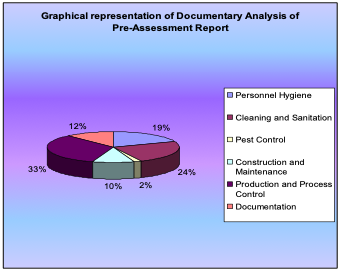
The pie graph in Figure 3 shows that the Production and Process Control aspect accounted for the highest percentage findings i.e. 33%. This was followed by the Cleaning and Sanitation aspect which accounted for 24% of the findings; Personnel Practices which accounted for 19% of the findings; Documentation which accounted for 12%; Construction and Maintenance which accounted for 10% of the findings and Pest Control which accounted for 2% of the findings. As this was an assessment of the current status of the facility, the report guided the HACCP Team to prioritize the aspects of the implementation process.
Similar surveys were conducted by Bernard etal (1997) where priorities and responsibilities were assigned to individuals to allow for several tasks to be completed concurrently with the development and implementation of the HACCP system. This is explained further in 4.2 of the study.
4.2 Results for Documentary Analysis of Minutes of HACCP Team Meetings
The minutes of the HACCP Team Meeting from August 2006 to December 2008 was analyzed.
The HACCP Team Meeting Minutes were analysed for the following periods:
08 August 2006 to 14 December 2006
18 January 2007 to 6 November 2007
11 January 2008 to 2 December 2008
A total of 84 issues were discussed in 2006, 237 issues in 2007 and 196 issues in 2008. The issues of the minutes were then categorized according to the GMP aspects as well as the documentation category and the frequency of issue was calculated as per percentage of overall issues for the respective year. These results are shown in Table 2 and the comparative graphical representation of frequency of issues in seen in Figure 2 below.
Figure 2 Comparative Graphical Representation of the frequency of issues discussed at HACCP Team Meetings from 2006-2008
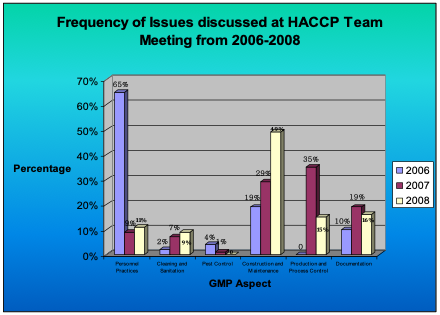
A comparative analysis of the HACCP meeting issues for a 3 year period (2006 -2008) can be seen in Figure 2. An 86% decrease was noted in the issues discussed relating to personnel practices from 2006 to 2007. However, a slight increase of 18% was noted from 2007 to 2008.
It is also worthwhile noting that there was an increase of 34% of issues discussed with regards to Construction and Maintenance from 2006 to 2007, and a further increase of 41% in maintenance issues from 2007 to 2008. This could be due to a facility that increased in size or the lack of a designated on site maintenance supervisor.
An increase in issues with regards to the Cleaning and Sanitation aspect was also noted.
A 71% increase was noted from 2006-2007 and a 22% increase noted in 2008. Possible reasons for this could include the amalgamation of the cleaning team with the quality team under the management of the Quality Assurance Manager. An assessment was immediately conducted on the nature of the cleaning chemicals, quality of equipment used and methods of cleaning which led to improvements.
An increase of 47% was noted in 2007 with regards to the Documentation aspect which involved the compilation of policies, procedures, checklists and the training thereof.
A 75% decrease was noted in the issues regarding Pest Control. This could be due to the fact that this service is outsourced and a better quality service provider was selected in July 2007.
4.3 Results for Documentary Analysis of Internal Audits for 2006, 2007, 2008
The Internal Audit Reports for 2006, 2007 and 2008 were analyzed to determine the GMP category of issues that were dealt with during this time. The frequency of issue per GMP category was then calculated for each year and the findings were summarized with the comparative analysis for each year displayed in Figure 3.
Figure 3 Comparative Graphical Representation of the frequency of internal audit findings for 2006-2008
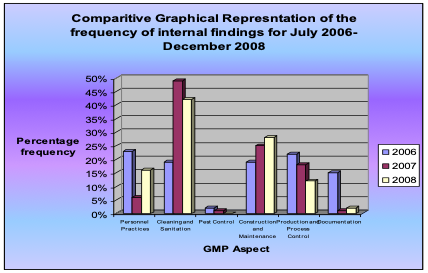
A steady increase was seen in the total number of findings per year. An increase of 79% was noted from 2006-2007 and an increase of 4% was noted from 2007 to 2008.
The GMP aspect with the most number of findings in 2006 was Personnel Practices which accounted for 23% of the findings followed by Production and Process Controls which accounted for 20% of the findings, and both Cleaning and Sanitation and Construction and Maintenance issues which accounted for 19% each and Pest Control which accounted for 2% of the total findings. The Documentation aspect accounted for 15% of the findings. This is shown graphically in Figure 3.
In 2007, the Cleaning and Sanitation aspect accounted for the highest number of findings i.e. 49%. This was followed by Construction and Maintenance findings which accounted for 25% of the findings, Production and Process Control which accounted for 17% and Personnel Practices which accounted for f6% of the findings. Pest Control and Documentation accounted for 1% each respectively.
In 2008, the Cleaning and Sanitation issues accounted for 42% of the total findings, Construction and Maintenance accounted for 28% of the findings, Personnel Practices accounted for 16%, Production and Process Control 12% and Documentation accounted for 2% of the findings. There were no findings with regards to Pest Control.
The comparative analysis displayed in the bar graph in Figure 3 shows that the Cleaning and Sanitation issues accounted for the highest number of findings throughout the study followed by Construction and Maintenance issues.
The frequency of internal audits conducted by the Quality Assurance Manager and Quality Control Officer increased from monthly in 2006 and 2007 to bimonthly in July 2007 and then to weekly from 2008 onwards. This audit consisted of a walkthrough the facility to determine adherence of the plant, personnel and processes to the GMP system as well as a documentation review of the previous week’s completed checklists or records.
At the start of the implementation process in July 2006, issues concerning Personnel Practices accounted for the most number of findings. This corresponds to the fact that in 2006, adequate staff facilities were erected, protective clothing was renewed and plans were in progress to source an external service provider for laundry. A reputable and approved service provider was selected in 2007.
The GMP and HACCP implementation process was not without its challenges as seen in the minutes of the HACCP Meetings and findings of internal audit reports. Below are a few key aspects that aided the process.
- Management Commitment which does not only involve the allocation of funds but also participation in the implementation process. The first task the Quality Assurance Manager undertook was to inform management that any expectation of HACCP certification within a year was unreasonable. Management participation extended to external regulatory audits and customer audits. Throughout the process management was informed of the HACCP Team’s progress by means of the minutes and feedback at management meetings.
- Teamwork as a result of communication between departments. As the HACCP Team was multidisciplinary, each department was represented and the Meetings became an ideal forum to resolve food safety related issues as well as some production issues. The team was involved in the compilation of procedures relevant to their departments as well as the review in the final documentation prior to implementation.
- Documentation and Record keeping had to be practical, realistic and accurate. It was necessary to ensure that the GMP and HACCP system did not become a ticking exercise on paper and that the relevant personnel completed the checklists as required. This was overcome by eliminating electronic sources of documents. Each department head received their weekly set of checklists at the beginning of the week and were required to submit all completed checklists to the Quality department at the end of the week. The completed checklists were then reviewed weekly and feedback given to the relevant departments.
- Internal Audits. In September 2007, the format of the internal audit report changed from a record of all non conformances to a checklist with a points system. The checklist was divided into two major categories with all areas divided between the inside and outside of the plant. The scores for each area were then added and a total percentage for each category obtained. The findings of the audit report were discussed at HACCP Meetings and the scores obtained for the week were displayed on the notice board for production personnel. It was observed that some personnel paid attention to these scores and would question a member of the quality department on the reason for a low score.
The weekly internal audits proved to be a catalyst in the implementation process as non conformances were identified and rectified on a weekly basis rather than a monthly basis.
- CONCLUSION AND RECOMMENDATIONS
The primary aim of the research study was to determine the viability of HACCP implementation in a SARMPP using the research method of documentary analysis of the following food safety related documents i.e.
- Pre-Assessment Audit Report
- Minutes of HACCP Team Meetings
- Internal Audit Reports
From the results obtained, the following can be deduced.
- It was found that the pre-assessment audit report provided detailed information on the non conformances of the plant with regards to HACCP implementation. The report highlighted that the highest number of findings related to the GMP aspect of Production and Process Control.
- The non conformances identified were taken into account in the detailed GMP and HACCP Action Plan that was compiled. This plan aided in the tracking of the implementation process. The action plan showed that an initial period of six months was required for the GMP system to be entrenched through training and implementation.
- The HACCP Team Meeting Minutes showed that the highest number of issues discussed dealt with Personnel Practices thus highlighting specific challenges faced by a developing country, followed by Construction and Maintenance.
- The internal audit reports showed that the highest number of findings dealt with the Cleaning and Sanitation of the plant followed by Construction and Maintenance.
The phased approach to HACCP implementation started with the building of a solid foundation i.e. a solid GMP system. The approach used in the case study resulted in the SARMPP obtaining their HACCP certification in October 2008 by a regulatory authority known as the South African Bureau of Standards. The success of the system as shown in the study comprises the following:
- Management Commitment
- Communication between departments
- Frequent internal audits
- Detailed action plan for the implementation process
- Training of personnel
- Accurate record keeping and documentation
- Creating ownership of the system among the different departments
The goal of the SARMPP in the case study was to obtain HACCP certification which was achieved at the end of the study. This achievement alone indicates that HACCP implementation in a South African Red Meat Processing Plant is viable thus ensuring that the primary aim of the research was achieved.
By conducting a documentary analysis on the various food safety related documentation, the practicalities of HACCP implementation were highlighted.
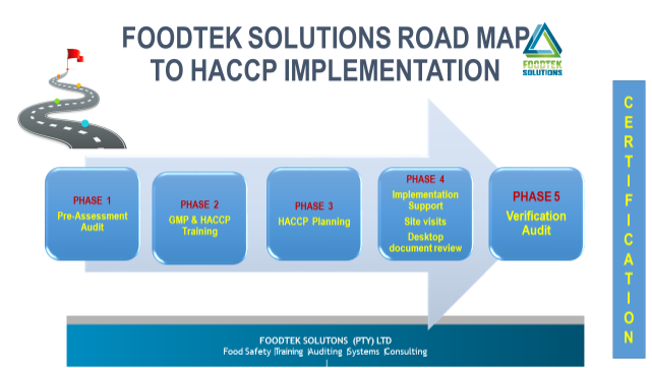
The findings of the research disproves the perception of the South African Red Meat Industry categorizing HACCP implementation as being ‘difficult’; impractical and use of trails of paperwork that hinders production. Find below the road to HACCP Implementation by a Red Meat Processor:
Written by: Reshmee Beedasie